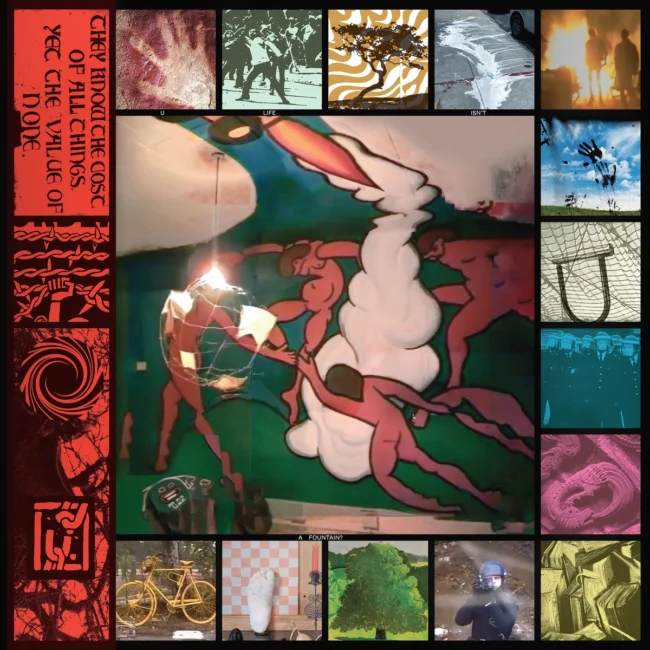
One year on from Life Isn’t A Fountain? – the Lex Records EP where archival post-punk was reanimated through meticulous sample-work – the elusive producer U returns with a project that reaches further back, and digs far deeper.
On ARCHENFIELD, U turns their attention to the Herefordshire borderlands, a region where English and Welsh histories intermingle, and where myth, memory and landscape are intertwined so tightly they become impossible to prise apart. The album functions like a form of auditory time travel: fourteen tracks constructed from traditional song, home-taped detritus, and fragmentary scraps of television, radio, film and YouTube, all layered into a drifting folkloric reverie.
Rather than a simple excavation of the past, U presents something more unruly and alive – an exploration of how stories mutate as they pass through generations, how landscapes carry collective memory, and how folklore persists not in museums but in the messy, contradictory ways people inhabit a place.
If Life Isn’t A Fountain? channelled Thatcher-era discontent through a cracked post-punk prism, ARCHENFIELD widens the frame, probing the fragile relationship between local identity and the rural environments that shape it. The album’s dusty pianos, murmuring drones and spectral voices sit somewhere between hauntology and field recording, hinting at ghosts that linger in hedgerows and churchyards, stories that have been bent and re-bent through retelling, and a modern England increasingly severed from the histories beneath its feet. U approaches this terrain with tenderness and curiosity, treating folklore not as fixed narrative but as a living, shifting archive – one that invites reinterpretation rather than closure.
To mark the release, U delivers IA MIX 397, extending the thematic thread of rebellion, unrest and cultural excavation that runs through their work. Set against the decaying optimism and alienation of Thatcher-era Britain, the mix digs deep into U’s personal record collection, unearthing forgotten fragments and overlooked influences that reshape into a compelling meditation on the fringes of pop music. Moving through post-punk, new wave, progressive rock and the many micro-scenes splintering outward from that era, U revisits a time when recorded music was both abundant and disposable – discarded as quickly as it was invented.
In doing so, IA MIX 397 mirrors the album’s core concern: how meaning persists in the things we leave behind, and how the remnants of one era can speak powerfully to the uncertainties of another.
Review by Will Patterson
"U studies how the natural landscape takes on a magical quality as society
attaches meaning to it, as newts become dragons, and tree rot becomes
an apocryphal tale about Jesus drowning children. Normal stuff."
It’s been said that people are defined by the landscape they live in, but less is said about how societies project their own identities back into the landscape, how the shape of the land takes on their traumas, their memories, and the stories that define them. It was Edward Said who proclaimed that geography exists as a “socially constructed and maintained sense of place”, where physical location gets its mythological significance via the invention of narrative, a kind of collective memory shared by the locals.
In his new album ARCHENFIELD, released on Lex Records, mysterious producer U delves deep into the landscape and folklore of a swathe of Herefordshire land, located on the England/Wales border.
Weaving together fragmentary scraps of television, radio, film and YouTube recordings, folk music and his own production work, U constructs a patchwork of sound that, in all its jumbled nature, is an incredibly coherent examination of the myths, tales and traditions that exist embedded in the physical landscape of England, and our relationship (or lack thereof) with these elusive histories.
The very nature of the stories U hopes to convey through music – ghosts haunting the ruins of pagan churches, fantastic creatures roaming the hills, religious verse turned local tragedy – these are narratives that have been warped and distorted through their telling and retelling, through their interpretation and reinterpretation as they are heard. It is this act of free interpretation and the multiplicity of meaning that is so essential to the listening experience of ARCHENFIELD.
As we open with Urchins, we are introduced to a nursery-rhyme-playful yet somehow melancholic, wistful piano loop, a sound that recalls the work of The Caretaker in An Empty Bliss Beyond This World and earlier releases in the Everywhere At The End Of Time series.
There is significance in this comparison, as where Leyland Kirby utilises these haunting, familiar-yet-unfamiliar loops to map the internal degradation of memory in individuals suffering from dementia, U highlights the persistence of memory in the external world, in particular the collective roots and memories that tie us to the landscape. The instantly recognisable tones of a wood pigeon at the end of track provokes an immediate, almost visceral reaction of nostalgia, particularly for those whose growth into adulthood may have resulted in a move from the rural to the urban. Or, more simply, less time spent outside.
It is this reconnection with the memory of the pastoral, with natural landscapes and the stories that lie woven throughout them, that U attempts to achieve with ARCHENFIELD, and deftly sets up with this opening track. With what must have been a monumental task in searching and sampling audio archives, the album leads us from more fuzz-laden pianos set against a child’s solo vocals on Is It A Kind Of Dream?, to the distorted organ-like samples and heavy vinyl crackle on Avenbury Organist, a track dedicated to the eponymous ghost said to haunt the church of St. Mary’s.
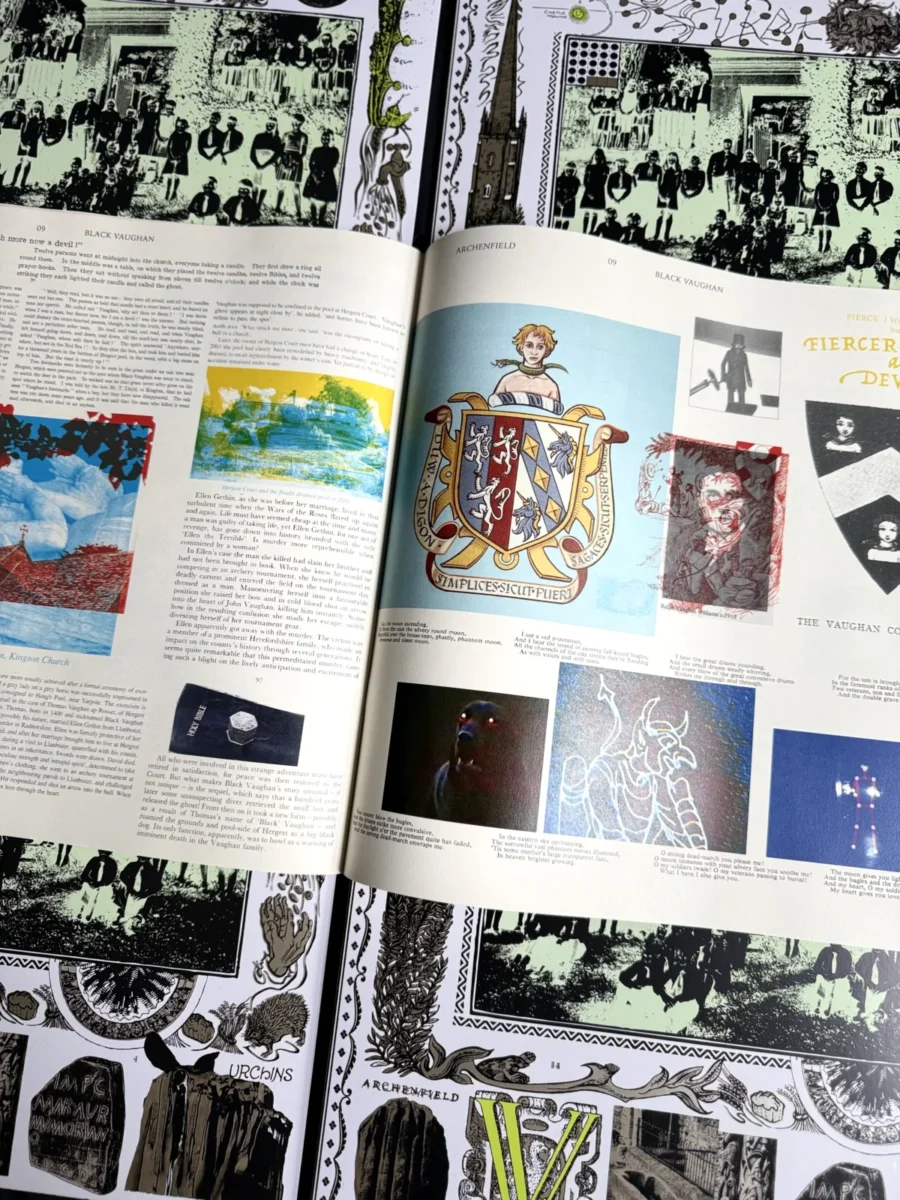
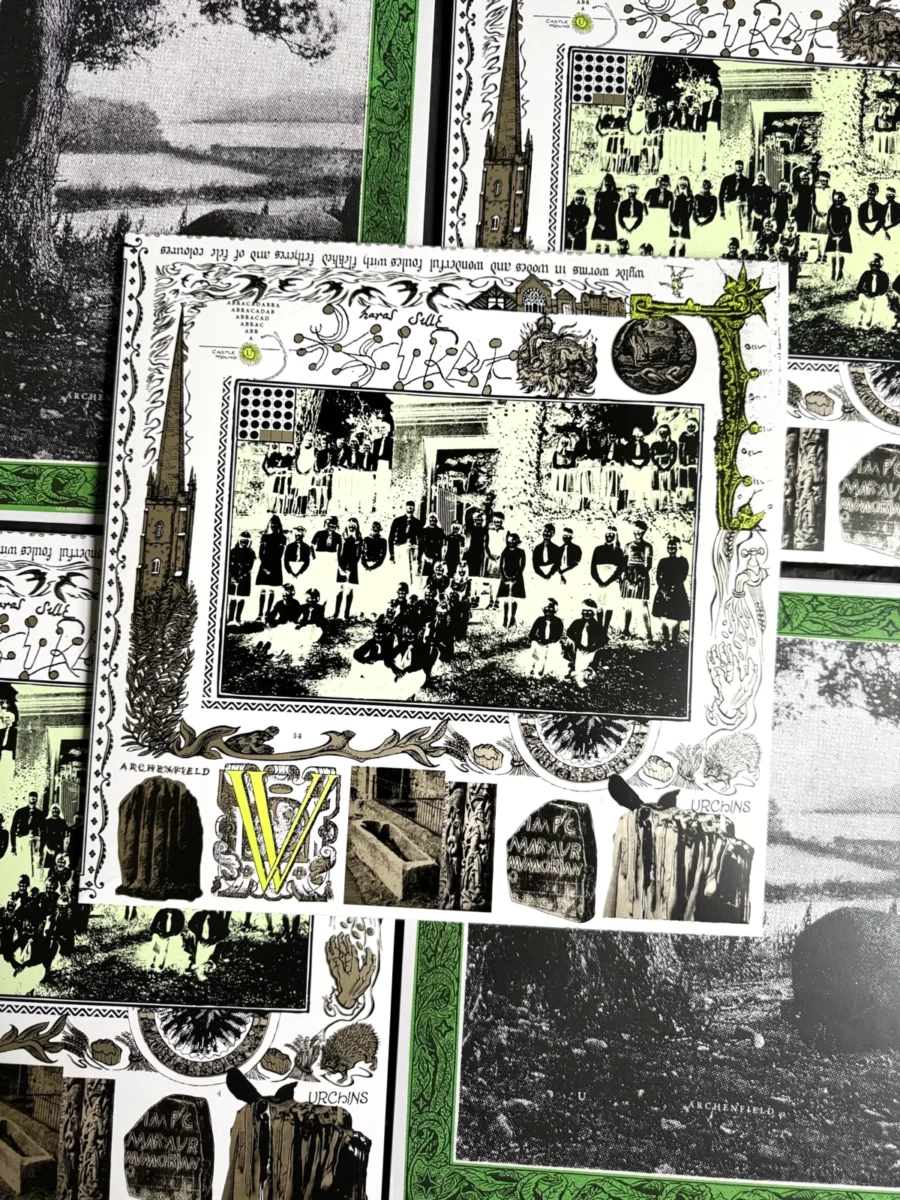
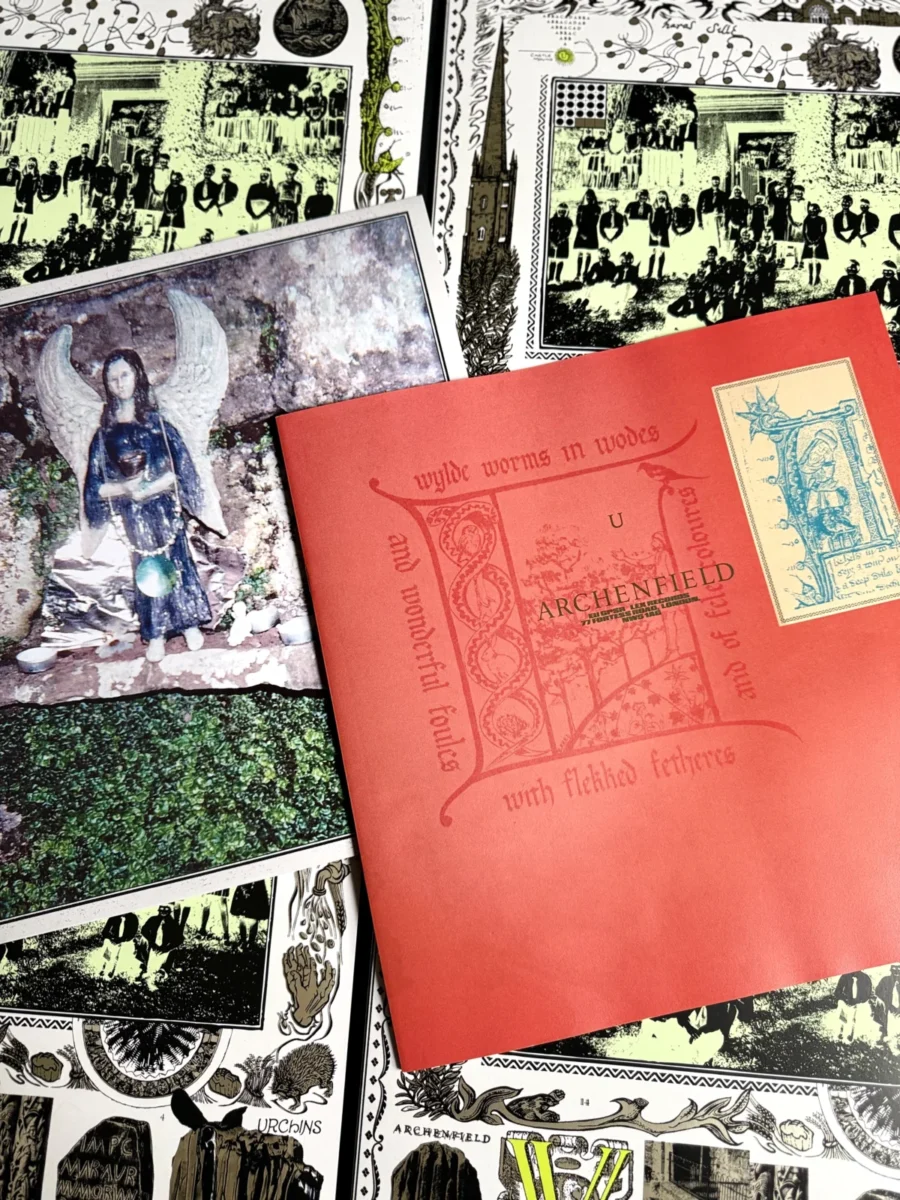
The concept of hauntology, of presences that seem to almost enter the mise en scène of the album and then fade, persists throughout. In the accompanying 24 page visual companion to the physical record, the listener is provided with multiple fragments of retellings of ghost stories and their supposed origins, of mysterious, inexplicable happenings – results of a society attaching significance to the narratives used to define a local landscape. These myths and folk tales permeate the dusty, summer haze of sound that ARCHENFIELD consists of. Vinyl crackle, soft drone work and distorted brass and woodwind, the timeless, nebulous unfolding of temporality, is punctured by spoken word samples that point to specific moments in time and space.
Half Moon hints at the power of the collective retelling of ‘unofficial’ stories over time, and The Bitter Withy tracks the evolution of these same stories as elements of religion, folklore and natural processes (the peculiar inside-out rotting of the willow tree) combine. In these tracks U studies how the natural landscape takes on a magical quality as society attaches meaning to it, as newts become dragons, and tree rot becomes an apocryphal tale about Jesus drowning children. Normal stuff.
"The album mirrors the very process of remembering, the impossibility
of reproducing a story exactly as it happened, embracing the natural
changes that occur in narratives as memories and ghosts upstage and
interrupt ‘coherent’ accounts of how things came to be the way they are."
A note on the importance of the rural in all of this. U is highlighting the multi-interpretive nature of these narratives through the medium of sound (along with the visual aid of the booklet), a rejection of ‘official’ history that can, and often is, used to advance notions of an oppressive, colonial or neo-capitalist nature. Space and geography, in urban environments, is increasingly losing this quality of open-interpretation, of stories bubbling beneath the surface of the tactile surfaces that constitute it.
Particularly in cities, a homogenisation of space, a rapidly increasing trend to literally overwrite the past is evident in the development of spaces for leisure, business or residence that are all, essentially, the same, and which are built with this very notion of ‘flattening out’ history in mind. Easier to direct the crowds to the tills when there are fewer surprises lurking round the corner. Simpler to predict behaviour when geography is reduced to a 2D map.
In rural environments, the rich patchwork of history still writhes close to the surface of the soil, as highlighted on Ariconium (about an ancient Roman station atop a local hill), where history takes a physical form in the shape of coins turned up by a farmers plough. Stories, histories, tales and fables that inform ways of life and provide locals with identity, exist everywhere – provided we are happy to look, and, essentially, to listen. On He’s Found It, we find this very process, and the process of the construction of the album, in action.
A clip of a local YouTube historian and his eerie discovery reflects this listening to the landscape, of engaging with it, distorting it, manipulating it in order to unlock the secrets it holds. What exactly has been found remains unclear to us and our narrator, who succinctly describes the effect of the album when he describes ghosts as “holes in time”. The album mirrors the very process of remembering, the impossibility of reproducing a story exactly as it happened, embracing the natural changes that occur in narratives as memories and ghosts upstage and interrupt ‘coherent’ accounts of how things came to be the way they are.
These secrets, these vague intimations of meaning, are, by nature, difficult to capture and share. But that is the entire point. The moment these stories become ‘official’, linear or consistent, is the moment they lose their magic. ARCHENFIELD engages with that challenge in all its multi-sensory, multifarious glory.
The album comes at a highly relevant moment. Increasingly fervent movements are adopting the Union Jack and the St. George’s Cross as emblems, but ask what these movements stand for and you’ll likely find an emptiness behind them. In this context, what the flags represent, and what these movements stand for, is defined by their opposition to stuff. There exists a rootlessness, a lack of English identity that breeds dissatisfaction. Without a connection to the landscapes, geographies and histories that create a collective identity, this dissatisfaction takes aim at the ‘other’.
It feels, then, like a natural progression in U’s work, following on from his Life Isn’t A Fountain? EP, which engages with the 80s Thatcherite discontent, or the ‘Postcolonial Discontent’ coined by Paul Gilroy, and inspires IA MIX 397, a heady mix of post-punk, new wave, progressive rock, and all other manners of angry weirdness. ARCHENFIELD shifts the focus to the contemporary yet timeless. A very modern disconnection with heritage, a heritage that has existed for centuries in the rivers, streams, woods and hills of the country.
These forgotten stories, the histories that can provide the common ground upon which to build identity, exist still. It’s shaky and ever-shifting ground, but on ARCHENFIELD, U demonstrates that we can still reach back and reconnect with these stories, these memories and ghosts, if only we listen hard enough.
ARCHENFIELD’ is out now via Lex Records. Buy vinyl from Inverted Audio Record Store. U performs ARCHENFIELD live at Bermondsey Social Club on Tuesday 2 December, joined by special guest Memotone. RSVP.
TRACKLIST
1. The Cardiacs – Interlude
2. Alien Sex Fiend – Get Into It
3. British Standard Units – D’ya Think I’m Sexy?
4. Wild Willy Barratt & John Ottway – Headbutts
5. Gee Mr Tracey – You Make My House Shine
6. Hit Parade – Media Song
7. The (Hypothetical) Prophets – Person To Person
8. Annie Anxiety – Cynide Tears
9. Tango Twins – Life Support
10. Andy T – Tomorrow?
11. Porky The Poet – Nobby
12. Moonflowers – Warshag
13. Daevid Allen – Death Of Rock
14. Ian Ashman & The Breakdowns – Alone With You
15. Phlant Pendalar – Yr Ehedydd
16. Good News – Long Lost Cause
17. The Trogs – 66-5-4-3-2-1
18. Mark Ashton – Political Madness
19. Department S – I Want
20. Half Man Half Biscuit – I Hate Nerys Hughes
21. Snuff – Purple Haze
22. Perrey & Kingsley – Umbrellas of Cherbourg
23. Crime of Passion – Strawberries & Cream
24. Tin Tin – Kiss Me
25. The Associates – The Associate
26. Zeitgeist – Over Again (dub)
27. Atilla The Stockbroker – A Bang And A Wimpey
28. A Popular History Of Signs – Stigma
29. Furniture – Bullet
30. Fatima Mansions – Bertie’s Brouchures
31. The Damned – The Jackal
32. Dennis Nolan – Killer Thriller (remix)
33. Art Of Noise – Hoops & Mallets
34. The Flying Lizards – Gyrostatics
35. Coldcut – In Deep
36. Jane – I Slap My Belly
37. Desmond Simmons – A Caste From Hawaii
38. Canker Opera – White Coffins
39. Pigbag – Dozo Don
40. The Creatures – Sky Train
41. Soundtracks & Head – Ghost Train
42. Terminal City – Mugin For Unknown
43. Im Mac Logic – Logics of Emotion
44. Swell Maps – A Three Acre Floor
45. Gong – I Am Your Fantasy
46. Metabolist – Eulam’s Beat
47. Everything But The Girl – On My Mind
48. Yeh Yeah Noh – Zoological Gardens