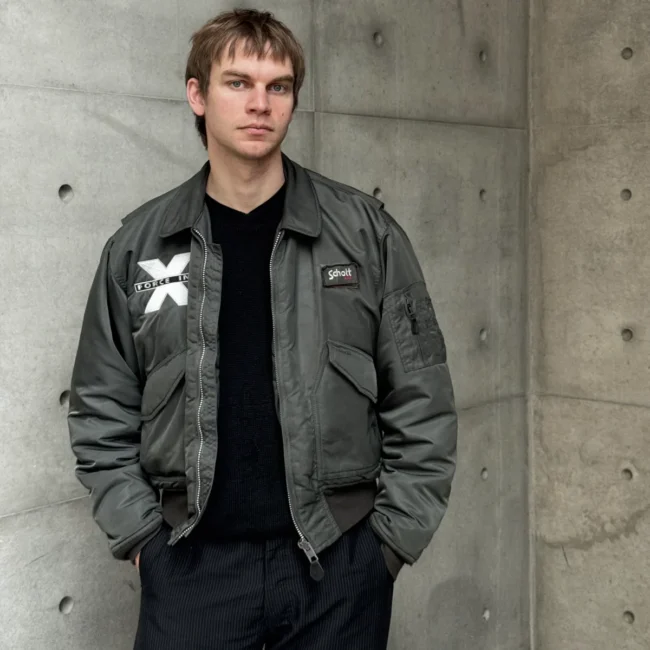
Emerging from the dense cultural ecosystem of Cologne, Max Hytrek – also producing under the name oskø – represents a new generation shaped as much by total access to music history as by deep, local immersion. Raised in a household where classical music was a daily language, with his mother performing as a cellist in the Duisburg Philharmonic, his path into sound was less a single turning point than a gradual convergence of influences. Early exposure to theory, composition and performance would later collide with the hypnotic logic of techno, forming the foundation of his current work.
That intersection found clarity through Cologne’s lineage, particularly via Kompakt, where Hytrek not only discovered records as a teenager but now works within its walls. What began as regular trips to the shop evolved into something closer to apprenticeship – an ongoing dialogue around repetition, reduction and the enduring power of the loop. Artists like Wolfgang Voigt and projects such as GAS gave form to ideas Hytrek had been intuitively circling, particularly around the emotional weight of minimalism and sound design.
His vinyl-only imprint Soundtrek extends this inquiry. Less a conventional label than an ongoing research project, it seeks to unpack what gives Cologne’s electronic music its distinctive sense of depth and timelessness. Built around loop-based structures, materiality and the passage of time, the project reflects a fascination with how sound evolves – and how it resists fixed meaning.
Rather than preserving tradition, Hytrek filters it through a contemporary lens. Limited pressings, a cohesive visual language and close alignment with trusted outlets point to a belief in music as both physical artefact and shared experience.
With Soundtrek, Max Hytrek is not just contributing to Cologne’s legacy, but actively interrogating how it continues to unfold. For this feature, Tom Durston sat down with Hytrek to explore his vision for the label, the music he is shaping, and how a new generation is engaging with – and extending – the enduring sound and legacy of Cologne.
Interview by Tom Durston
"We listen to these records together in the shop, and I keep asking myself
why this sound captivates me so much. What makes it so special? In a way,
I'd like to understand why, but to do that I first need to figure out which
aspects interest me most. With Soundtrek, I'm trying to filter and process
exactly that."
You’re part of a generation that had the entire history of recorded music at your fingertips from a young age. Was there a specific moment, record, or artist that first made you think — I want to do this — or was it more of a gradual pull into music?
It’s hard to say. My mum is a cellist and plays professionally in the Duisburg Philharmonic Orchestra. That’s why I have a completely different perspective on music and on how it fits into everyday life at a professional level. At home, we were always making music or talking about it.
When it comes to electronic music, one of the earliest motivations for me to develop in this direction was DJ Koze. His playful lightness has always fascinated, inspired and motivated me.
Cologne has such a distinct and storied electronic music culture. Did you grow up aware of that heritage, or did you discover it later? When did Kompakt, Wolfgang Voigt, and that whole lineage first enter your world?
I started DJing at around the age of 15. As I’m from the Ruhr region and it only takes about an hour to get to Cologne, I was a regular at Kompakt right from the start, buying my records and discovering new music. Whenever we could and had a bit of money for new records, we’d make the pilgrimage to Cologne.
Even back then, I was aware of the significance Kompakt held within the scene. However, since I’ve been working there myself, a whole new dimension has opened up, revealing just how far-reaching Kompakt’s influence really is.
When did you actually start producing, and what did those early experiments sound like? Were you immediately drawn toward the kind of textural, loop-based ambient techno you’re making now, or did you go through very different phases before landing here?
I think I started playing around with Ableton when I was about 14 or 15 – definitely before I started DJing. I can’t really remember any specific projects, but I do recall that it was very much about samples. Above all, I used to sit at the breakfast table with my mum and talk about music theory in classical music – like Wagner, Kodály or Bach – and how it could be applied to electronic music.
At the time, my mother had also played with Carl Craig, Moritz von Oswald and Francesco Tristano at the Ruhrtriennale Festival. It all sort of hung together, but it was more about how to connect these two worlds – classical and techno in an interesting way.
Back then, I didn’t yet know about GAS or Wolfgang’s approach to the subject. When I discovered them, I’d finally found what I’d been searching for for a very long time. For me, though, it all remained purely theoretical at the time; I suppose I just needed a bit more time to let it sink in before I could understand what I was looking for.
"I feel a great deal of respect and, at the same time, a total openness
within the scene – it's all about sharing ideas and supporting one another.
That has nothing to do with age, and that's exactly what I think is brilliant."
How did the opportunity to work at Kompakt come about? For someone your age, walking into what is essentially a living archive of Cologne’s electronic music history — what was that like in those first weeks?
My sister had actually started working in the shop a few years earlier. After finishing my degree, I moved to France, where I became an apprentice as a shipbuilder and worked in that field – so it was something completely different.
At some point, I wanted to take some time out and move to Cologne for a few months. As it happened, Kompakt was looking for a temporary replacement in sales during exactly that period – and one thing led to another. Even in the first few weeks, it quickly became clear to me just how much there was still to discover there. And to be honest, it still feels exactly the same today.
You talk about the conversations at Kompakt centring on the magic of the loop — the straight bass drum, repetition, time. Can you describe what that daily immersion has actually taught you that you couldn’t have learned just from listening at home?
For me, it’s probably the direct exchange with the whole team that’s so special. You can imagine it as being able to ask your greatest artistic idols questions directly about your own work. Each individual has their own vision of Kompakt, and all these different facets together create the big picture.
It’s just incredible how openly we can share our projects and music with one another. It reminds me a lot of my photography studies at the Folkwang University of the Arts: you’re in a class, showing each other your work, discussing it, developing it further and working together to find solutions to problems. The only difference is probably that you also have to pack and post records on the side.
If you had to point to a handful of records or artists from the Kompakt catalogue that have shaped your understanding of what music can do — not necessarily the most famous, but the ones that hit you personally — what would they be, and why do those particular records still hold that power for you?
I think the records speak for themselves:
– Markus Guenter – In Moll
– Dettinger – Puma
– GAS – Pop
– Burger/Ink – Las Vegas
– MINT – Phonogam
– Pop Ambient 2010
Wolfgang Voigt is obviously a towering figure in this world — both through GAS and through imprints like Profan, which you name-check directly. What is it specifically about his approach that resonates with you? Is it the philosophy, the sound design, the restraint, or something harder to articulate?
What particularly interests me about Wolfgang’s work is, above all, its radical nature in terms of the impact of his music or images. For me, his work is primarily about impact, and this cannot be provoked or forced.
He is very keen to emphasise that art is not democratic. For me, this also applies to the impact of a work: it is non-negotiable and cannot be debated. I find it extremely inspiring and greatly appreciate how Wolfgang manages to create an impact in such a starkly reduced and focused way. That is something we both share very strongly.
"The vinyl record is an industrial product, yet it also aims to be very
personal. Music doesn't have to work on every medium; sometimes it is simply
tied to the physical material and can only unfold there."
You’re actually making music with Wolfgang Voigt as part of Pop Vampires Cologne — which is a remarkable thing given how central he is to your influences. How did that collaboration come about, and what does the project stand for? Does working directly with him change how you think about your own music, or even how you hear the Kompakt catalogue you’ve grown up with?
It’s a real honour for me to be working on this project with Wolfgang, and I appreciate it immensely. We’re also having a lot of fun with the project, as you can perhaps see from our video for Karianne.
For Pop Vampires Cologne, our new label Erdgeschoss is particularly important. Wolfgang explained it beautifully in the press release:
“The Erdgeschoss label celebrates the freedom of sound and vision at the bar of life, just like football – only with a bass drum instead of a ball. And with beer. Because even with a record, the round thing has to go into the square one.”
At the Erdgeschoss label (German for Ground Level), everything revolves around the physical and our connection to the world – but in our very own, lively way. At Kompakt the ground level is represented by the distribution office and the record store.
With the PVC project, we wanted to create a record that doesn’t exist anywhere else. One that couldn’t have been created anywhere else either. We wanted to make a record that nobody expected, but which we are firmly convinced is needed. The Karianne EP is a statement and a very clear launch for the Erdgeschoss label: “Because: anything goes…”
You describe noticing local scenes blending internationally — that it’s become harder to pin a sound to a city. As someone embedded in one of electronic music’s most geographically defined scenes, do you feel pressure to protect that identity, or is Soundtrek more about understanding it for yourself?
Perhaps it is more a matter of making my personal engagement with the question of identity transparent to the outside world. This is not a matter of criticism or anything of the sort. For me personally, it is important to experience, share and carry on this kind of musical culture.
Soundtrek is almost as a research project — field research into the loop and Cologne’s sonic identity. Where did that concept come from? Was there a conversation, a record, or a moment of frustration that made you think you needed your own label to explore this properly?
The project – or rather, the idea behind it – came about through discovering the early releases on Kompakt and everything that goes with them: early records by Dettinger, Markus Guenter or Wolfgang Voigt, for example.
We listen to these records together in the shop, and I keep asking myself why this sound captivates me so much. What makes it so special? In a way, I’d like to understand why, but to do that I first need to figure out which aspects interest me most. With Soundtrek, I’m trying to filter and process exactly that.
You’re notably younger than many of your contemporaries in the Cologne scene. Did that ever feel like a barrier — to starting a label, to being taken seriously in a world where so many of the key figures have been at this for decades? Or has your age actually given you a different kind of freedom?
To be honest, I don’t think age plays a big part here. You can be very young and still have a wealth of experience with club culture and music. Just as easily, you can find your feet and get started later on.
I feel a great deal of respect and, at the same time, a total openness within the scene – it’s all about sharing ideas and supporting one another. That has nothing to do with age, and that’s exactly what I think is brilliant. Perhaps what’s important here is to reflect on the essence from which the scene emerged. That’s where we all agree and enjoy what we’re doing.
"When I'm producing, I try to deliberately build loops that evolve over time.
 Perhaps the focus here is more on how the loop unfolds independently
and can surprise itself."
Soundtrek002 is pressed to just 100 copies. In an era where music is more accessible than ever — something you touch on yourself — what does that kind of deliberate scarcity mean to you? Is it a statement, a practical choice, or both?
That’s a good question, one to which I can only give a very contradictory answer – or perhaps one I’d like to answer in a deliberately contradictory way. Basically, accessibility for everyone is very important to me.
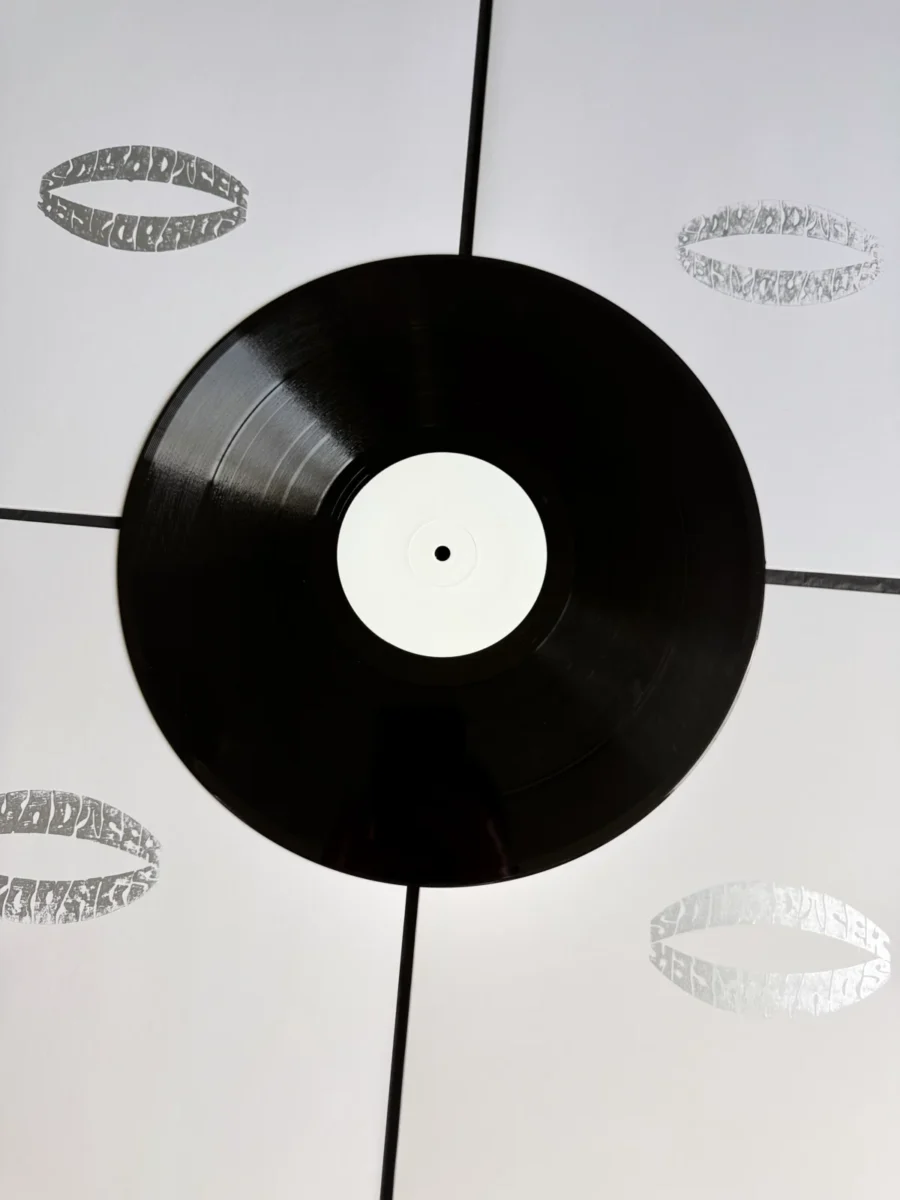
On the other hand, I work in a record shop and would like to offer it something exclusive, whilst at the same time making a certain statement. The vinyl record is an industrial product, yet it also aims to be very personal. Music doesn’t have to work on every medium; sometimes it is simply tied to the physical material and can only unfold there.
You write beautifully in your statement about techno’s relationship with time — how a loop can feel just as powerful whether it was made thirty years ago or an hour ago. When you’re producing, are you consciously trying to make something timeless, or is that quality something you only recognise in a record after the fact?
We can already see from your question the significance of time in this whole subject – as well as its multifaceted influence on our musical and artistic work. Wolfgang and I often find that some projects need an ‘incubation period’.
In this context, time is a very powerful tool for our own work, but at the same time it is also the toughest test of its viability or existence. In a way, one has to submit to this, because we have no influence over the effect of time. When I’m producing, I try to deliberately build loops that evolve over time. Perhaps the focus here is more on how the loop unfolds independently and can surprise itself.
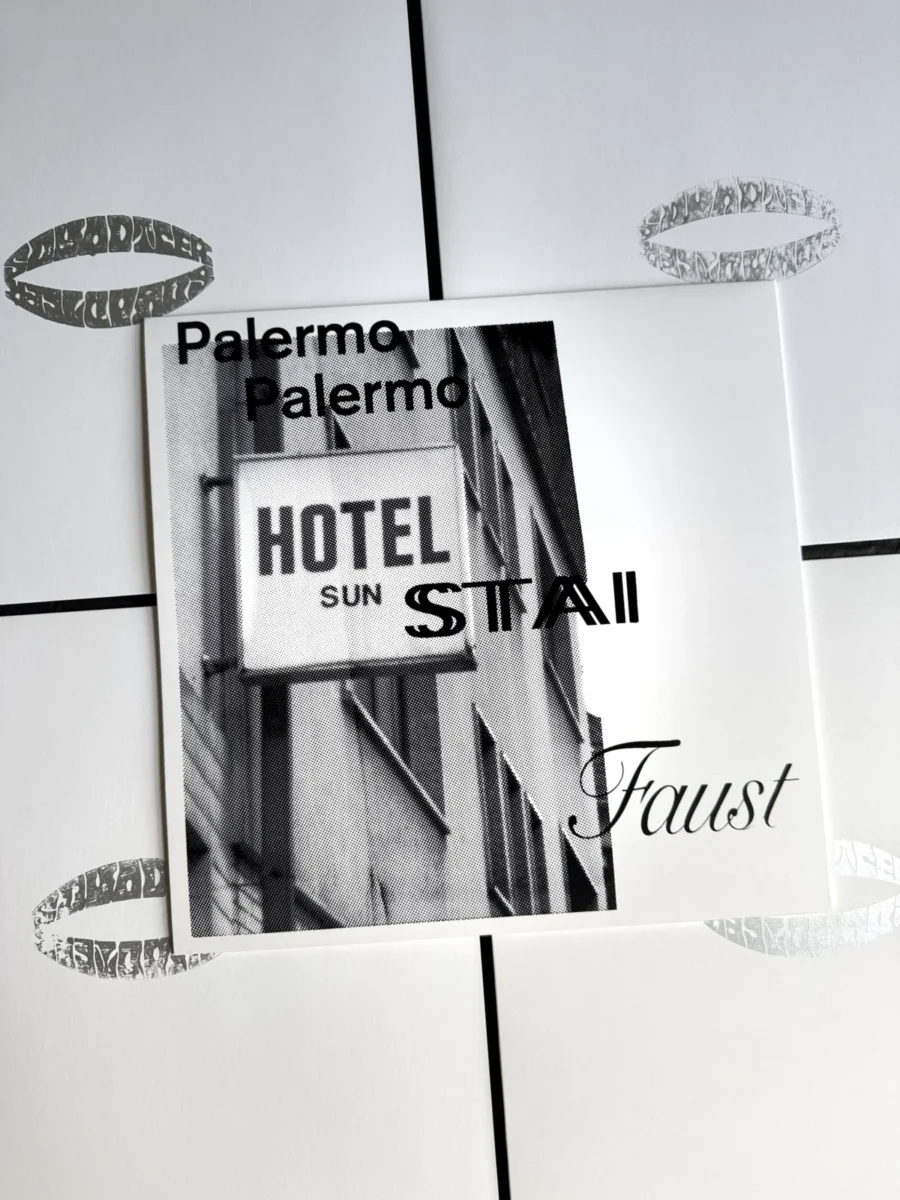
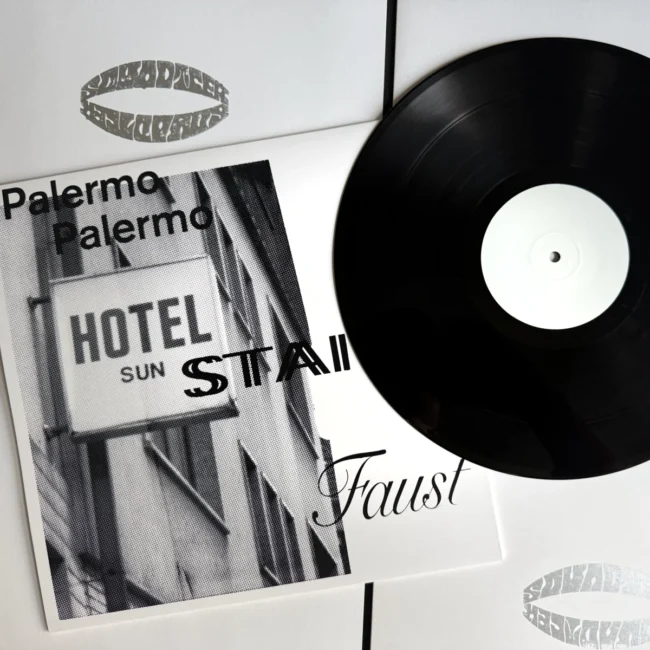
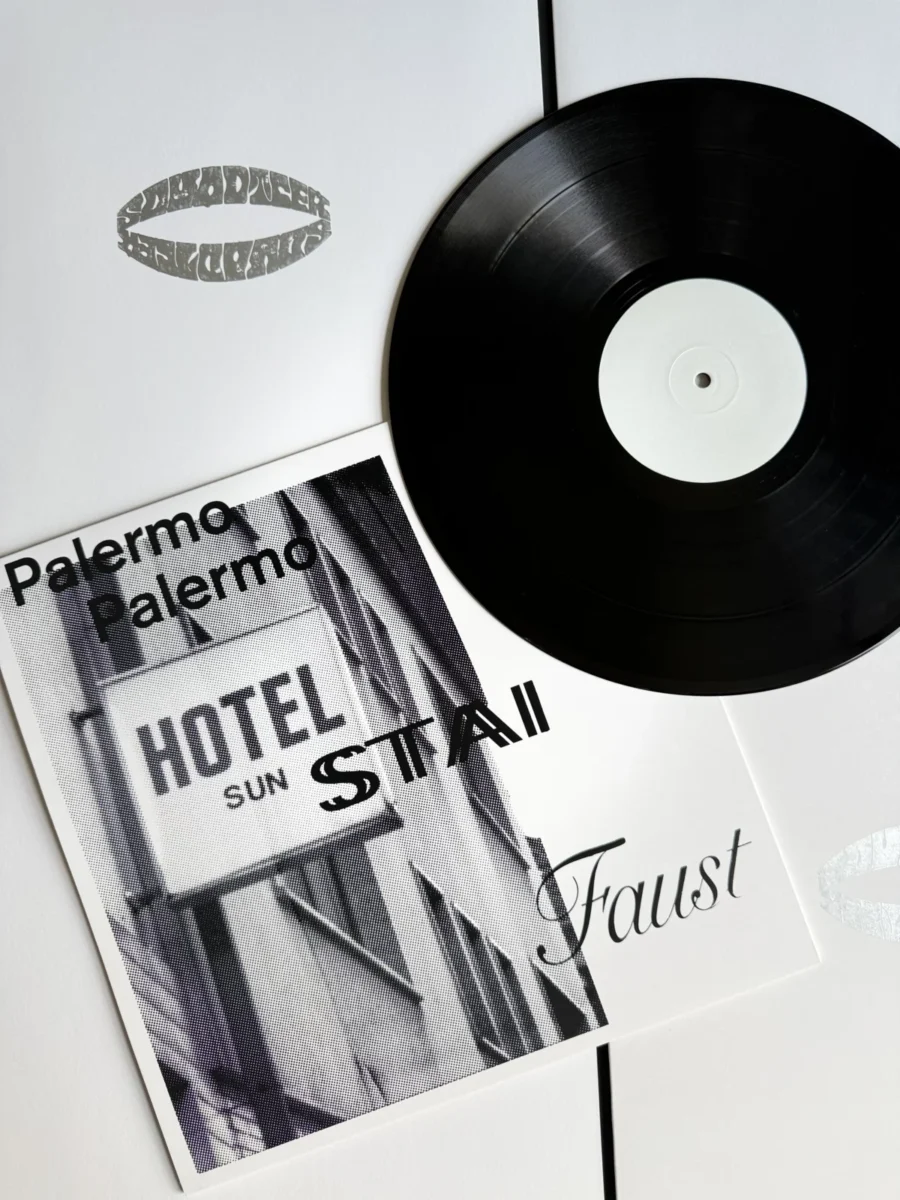
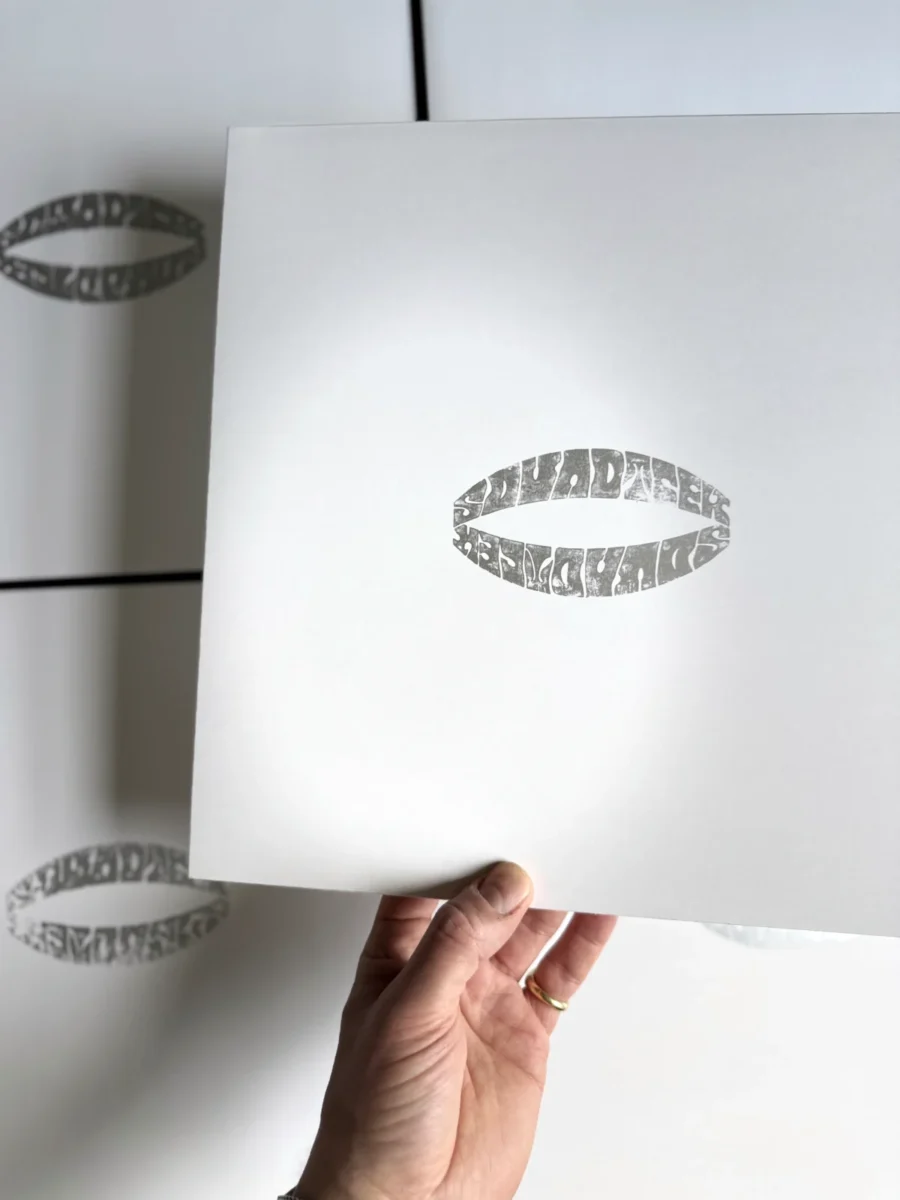
Both Soundtrek001 and 002 share the same visual identity — a silver ring spelling out Soundtrek. It’s a striking and immediately recognisable image. Where did that concept come from, and what does it mean to you? Is the ring intended to echo the circular, looping nature of the music itself, or does it carry a different significance — something more personal, or tied to the idea of the label as an ongoing series?
Soundtrek’s visual identity is a central component of the project. It was clear from the outset that it would be a serial work defined by different colour codes. I’ve always found it fascinating when people talk about the black or white Soundtrek.
The choice of colour is rooted in the context of the music: the black edition is more deep, rock-oriented and minimal, whilst the white one revolves more around wave-like structures or shadowy forms – perhaps it’s allowed a touch of glamour too.
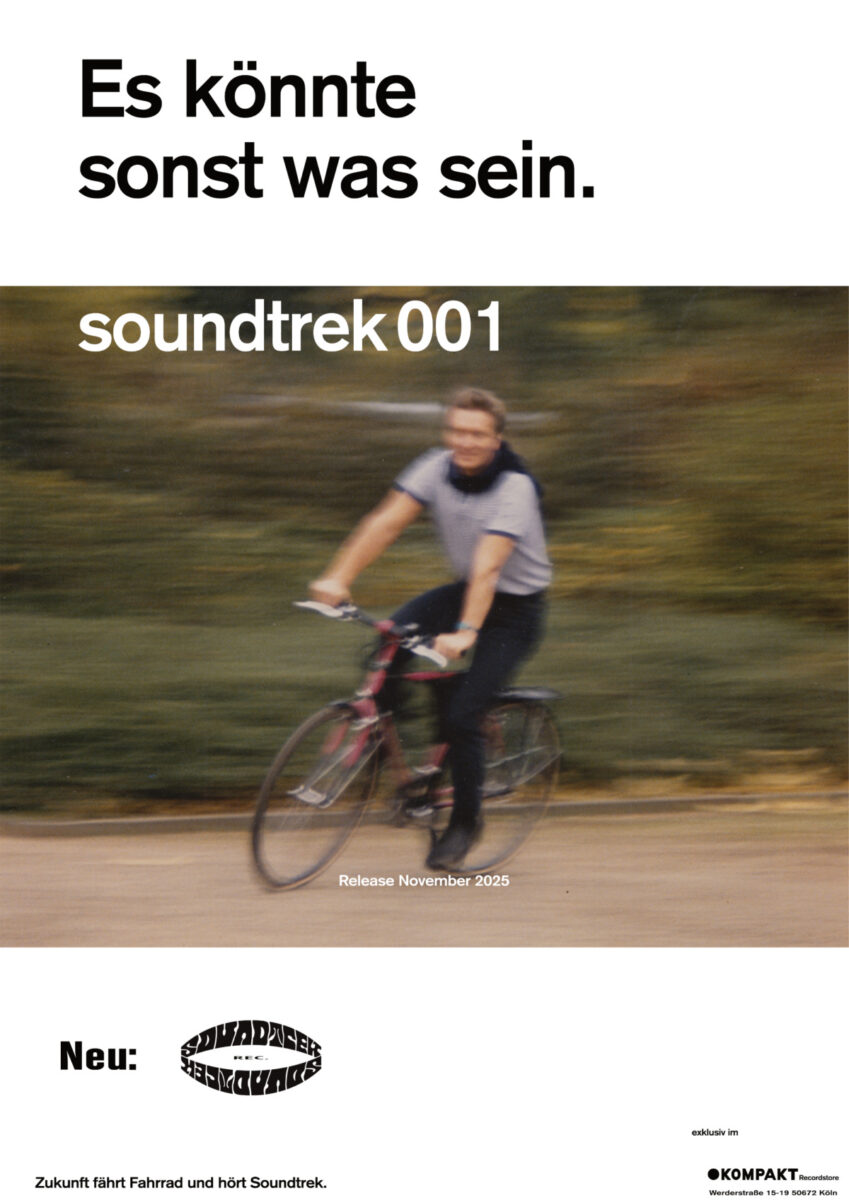
Each release also came with its own series of posters, which I distributed in Cologne. The posters mostly draw on family photo archives. One, for example, shows my father on a bicycle, with the caption: ‘The future rides a bike and listens to Soundtrek.’
The logo itself is intended to represent loop culture without revealing it too directly or demonstrating it too blatantly.
With the second release, what did you want to do differently or push further compared to the first? The description talks about cinematic, meditative qualities and subtle rhythmic undercurrents — how do you balance that tension between abstraction and rhythm when you’re actually in the studio?
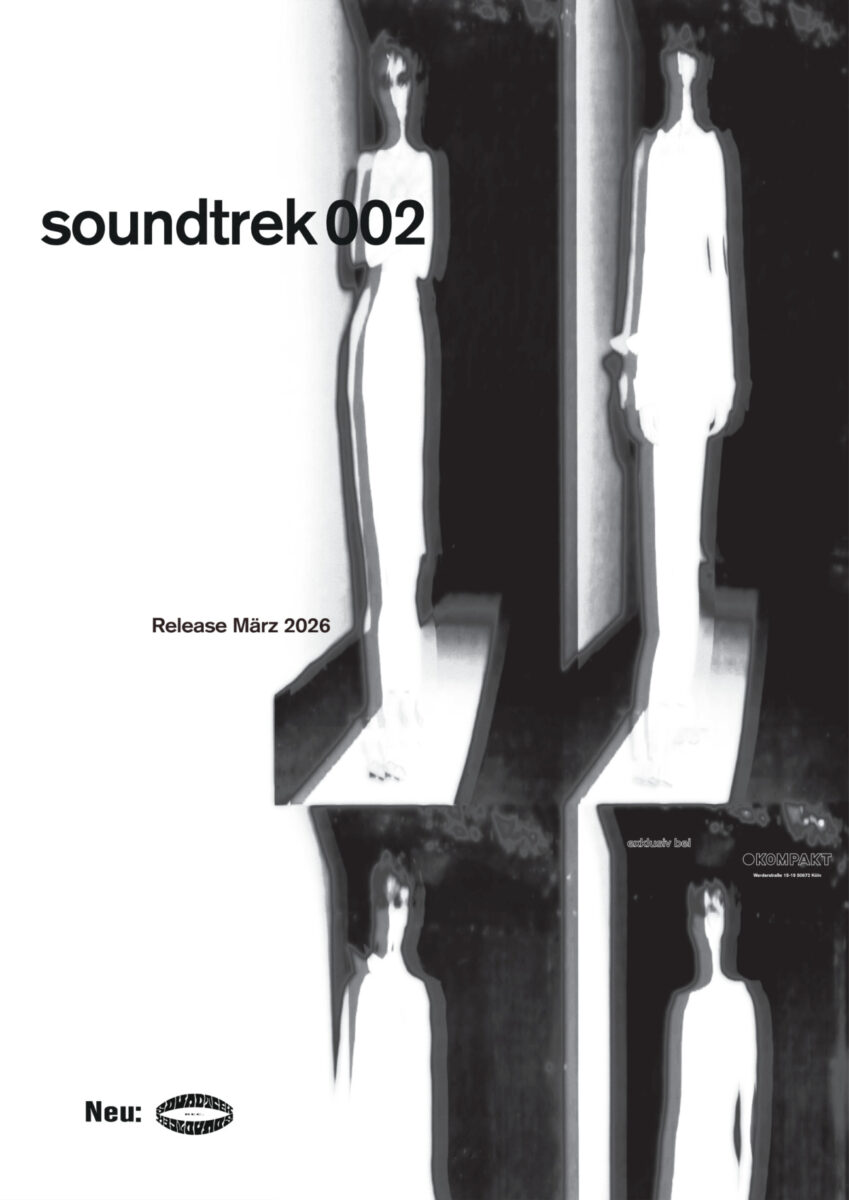
For the second release, I wanted to focus more on the intensity of individual elements and explore how they affect the track’s structure. At the same time, I wanted to avoid conventional song structures so as not to distract from what it’s really all about: the sound design and the loop. The idea was to present the individual elements as shadowy entities that appear and move in waves from left to right or from front to back.
"Soundtrek's visual identity is a central component of the project. It was
clear from the outset that it would be a serial work defined by different
colour codes. I've always found it fascinating when people talk about the
 black or white Soundtrek."
Inverted Audio Record Store is stocking Soundtrek002 exclusively in the UK. How important is it to you to align the label with specific outlets that share the same values and seriousness about the music? And what does it mean for a Cologne-rooted project to find that kind of dedicated audience in the UK?
My understanding of music isn’t primarily about publicity or visibility, but about connection and friendship. I find it incredibly wonderful how we can connect and share ideas with one another. This gives rise to new connections and ideas that develop organically – it’s always very inspiring.
Soundtrek is so deeply rooted in a sense of place and environment — Cologne, Kompakt, the people around you. Outside of music, what feeds your creativity? Are there other art forms, spaces, or experiences in the city that find their way into your work in ways that might not be immediately obvious?
Before I focused more on music, I studied photography at the Folkwang University of the Arts in Essen. There, I mainly explored photography and sculpture and how these can relate to their local and spatial context.
I also do a lot of photographic work, such as a portrait series for Denis Stockhausen’s MyDear parties at the Gewölbe Club in Cologne. There, we photograph the staff for the event posters. I also produce photo series for the community posts of Tresor West in Dortmund. As well as working at the record shop, I also do a lot of work in the graphics department at Kompakt.
My inspiration draws on many different time-based art forms or the places where they can be found, such as the Julia Stoschek Collection in Düsseldorf, the Deutsche Oper and Ballett am Rhein, or clubs like the Gewölbe.
You reference the idea of the Kompakt Factory — strength through diversity across a catalogue. Where do you want to take Soundtrek over the next few releases? Is this purely a solo vehicle, or do you imagine it expanding to include other artists who share this sensibility?
That’s a very good question! I’d like Soundtrek to continue to occupy a firm and distinctive place in our catalogue and to appeal to new audiences as well. The project is constantly evolving. Unfortunately, I can’t yet say exactly how this evolution will unfold or what it will look like, but that’s also what makes it so exciting and wonderful.
At the moment, I’m also working on a potential Soundtrek live performance. I’d like to use this to perform these loop-based explorations alongside traditional club culture. I’m really looking forward to seeing where this journey takes us.
Soundtrek002 is out now as a vinyl only release and is available to buy exclusively in the UK from Inverted Audio Record Store.
TRACKLIST
A1. Hotel Sun
A2. Stai
B1. Faust
B2. Palermo Palermo